Japan's AI Regulation Pivot 2026: From Adoption to Governance
AI Promotion Act, AI Basic Plan, privacy law revision, and the AI Governance Whitepaper 2026 — how Japan threads the needle between the EU AI Act and the US light-touch approach
Through 2025 and into early 2026, Japan executed a deliberate pivot in its AI policy posture. The country moved from a position of “encourage adoption” to one of “design governance” — and it did so without copying either the EU’s risk-based, penalty-backed AI Act or the increasingly fragmented US approach. For multinational AI vendors and Japanese enterprises alike, the shape of this middle path now matters more than ever.
The Four-Milestone Pivot
Four events define the transition.
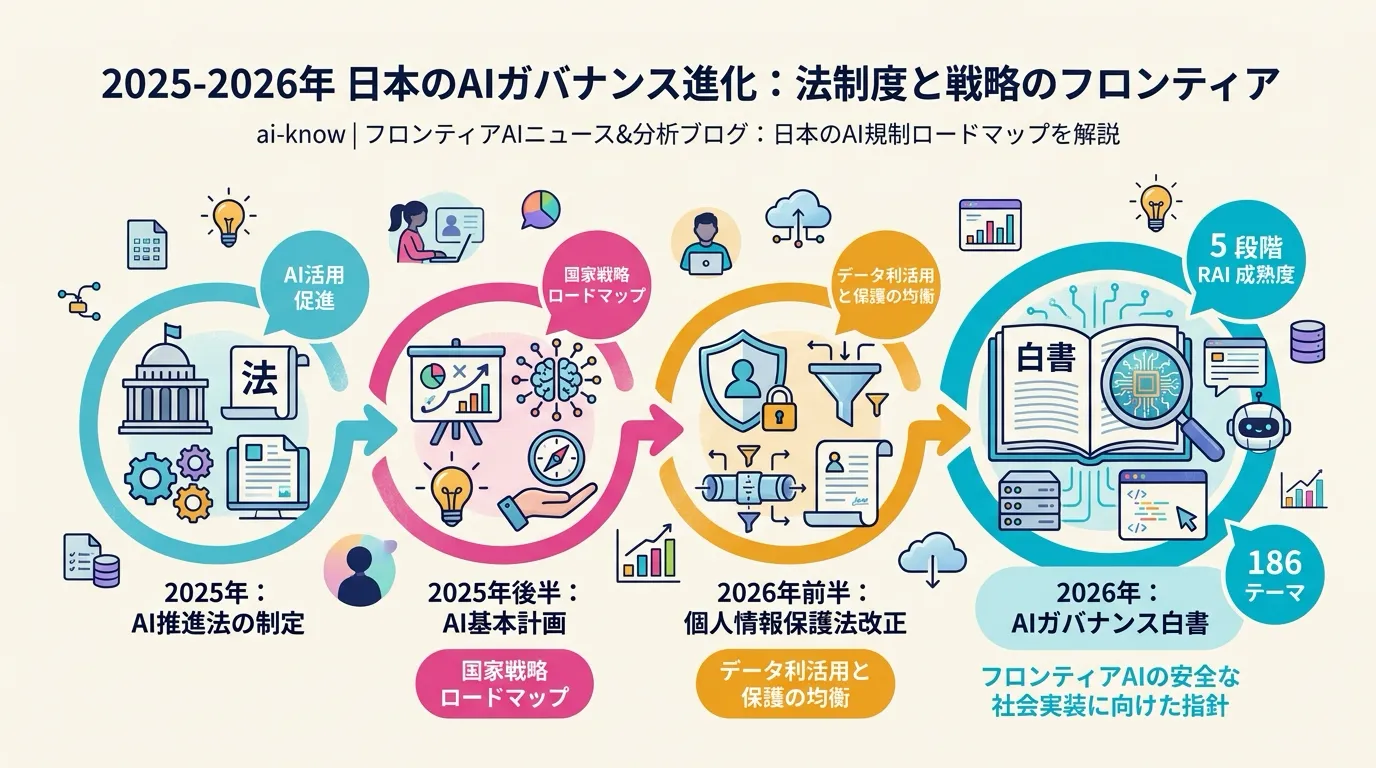
AI Promotion Act (enacted May 2025, in force September 2025). Formally the “Act on the Promotion of Research, Development and Utilization of AI-Related Technologies,” this is Japan’s first comprehensive AI law. Notably, it carries no penalties. The architecture is soft law: it sets out principles, requires the government to publish guidelines, and asks businesses to self-build compliance frameworks. The legislative intent was explicit — preserve speed of adoption while creating a coherent national framework that lines up with international peers.
AI Basic Plan (cabinet decision, December 2025). A national strategy document under the banner of [[concept/trustworthy-ai]]. It commits Japan to becoming a leader in trusted AI deployment, links research investment to industrial policy, and explicitly positions Japan as a Sovereign AI participant rather than a pure consumer of US frontier models.
Personal Information Protection Act revision (draft policy, January 2026). The Personal Information Protection Commission published its triennial review policy, which proposes conditions under which AI developers can use personal data for statistical purposes without individual consent. This unlocks a meaningful share of training-data friction that had been holding back domestic LLM and ML projects.
AI Governance Whitepaper 2026 (INGS, 2026). A non-government industry document but the most operationally detailed of the four. It introduces a five-stage RAI (Responsible AI) maturity model, integrates XAI implementation guidance, and consolidates 186 themes spanning finance, IT, and security. The recommendation aimed squarely at CEO and CIO readers: stand up an AI Governance Committee by Q1 2026.
Why Soft Law, and Why Now
Japan’s choice to go soft-law is not an accident — it is a positioning move. The EU AI Act forces global vendors to either carve out an EU-specific model lineup or risk fines tied to global revenue. The US, with federal-level rollback and state-level patchwork legislation, is hard to plan around. Japan offers a third option: enforceable expectations via guidelines, no fines, and a clear path to corporate self-governance.
For multinational AI vendors, that translates into low entry cost. Japanese deployment does not require a model variant. For Japanese enterprises, the trade-off is sharper: the government is not going to tell you exactly what to do, so you have to build the controls yourself — XAI, human-in-the-loop, audit logs retained for seven years, third-party risk reviews.
The RAI Maturity Model in Practice
The INGS five-stage model is becoming the de facto reference for Japanese boards. Stage 1 is ad hoc — AI usage exists but is not tracked. Stage 2 is structured — there is an inventory of AI use cases. Stage 3 is governed — there are policies, an AI committee, and review gates before deployment. Stage 4 is optimized — metrics feed back into the policy itself. Stage 5 is adaptive — governance evolves continuously with model and regulatory change.
MIT survey data cited in the Whitepaper is striking: companies with top-level AI governance show 58% achieving clear ROI from AI investment, versus a much lower rate in ungoverned organizations. Governance is not a tax — it is a precondition for measurable returns.
The Tooling Wave This Triggers
Three categories of vendors are about to find Japan attractive. First, model monitoring (Arize, WhyLabs, Datadog AI observability) — the Whitepaper’s audit-log retention requirements make this non-optional. Second, XAI / explanation layers and retrieval-grounding stacks that surface citations for every model output. Third, evaluation infrastructure — NICT’s AI safety evaluation platform, combined with the open-sourcing of the government model “Gennai,” creates room for a domestic evaluation tool ecosystem.
This wave parallels the agentic deployments already underway in Japanese enterprises (Toyota Finance’s UiPath case is a recent example). Governance buildout has to run on the same clock as agentic rollouts, or the latter quickly outpace the former.
What CEOs and CIOs Should Actually Do
Three concrete moves are now within scope.
- Stand up an AI Governance Committee at the executive level (the Whitepaper’s Q1 2026 deadline has already passed for some — closing the gap is now the priority).
- Map current AI usage onto the RAI five-stage model and pick the next-stage target with a 6–12 month horizon.
- Pre-position infrastructure for audit-log retention and XAI before regulatory expectations harden — the soft-law posture today does not preclude harder rules in the 2027 review.
The pivot is real, the architecture is distinctively Japanese, and the operational implications are immediate.
Sources: AI Regulation Overview and 2026 Trends — A-x Media (2026)
Related Articles
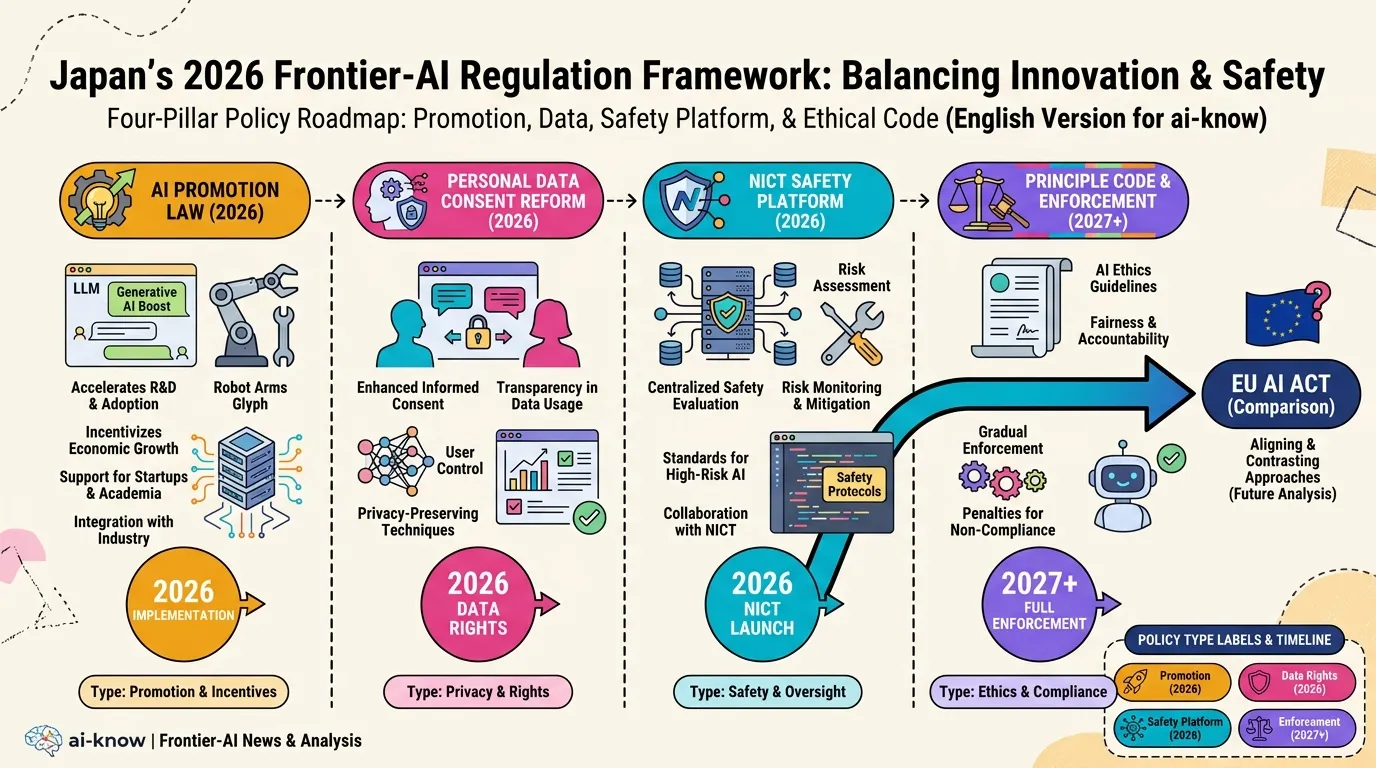
Japan AI Policy 2026: Promotion Law, Data Consent Reform, and the NICT Safety Platform
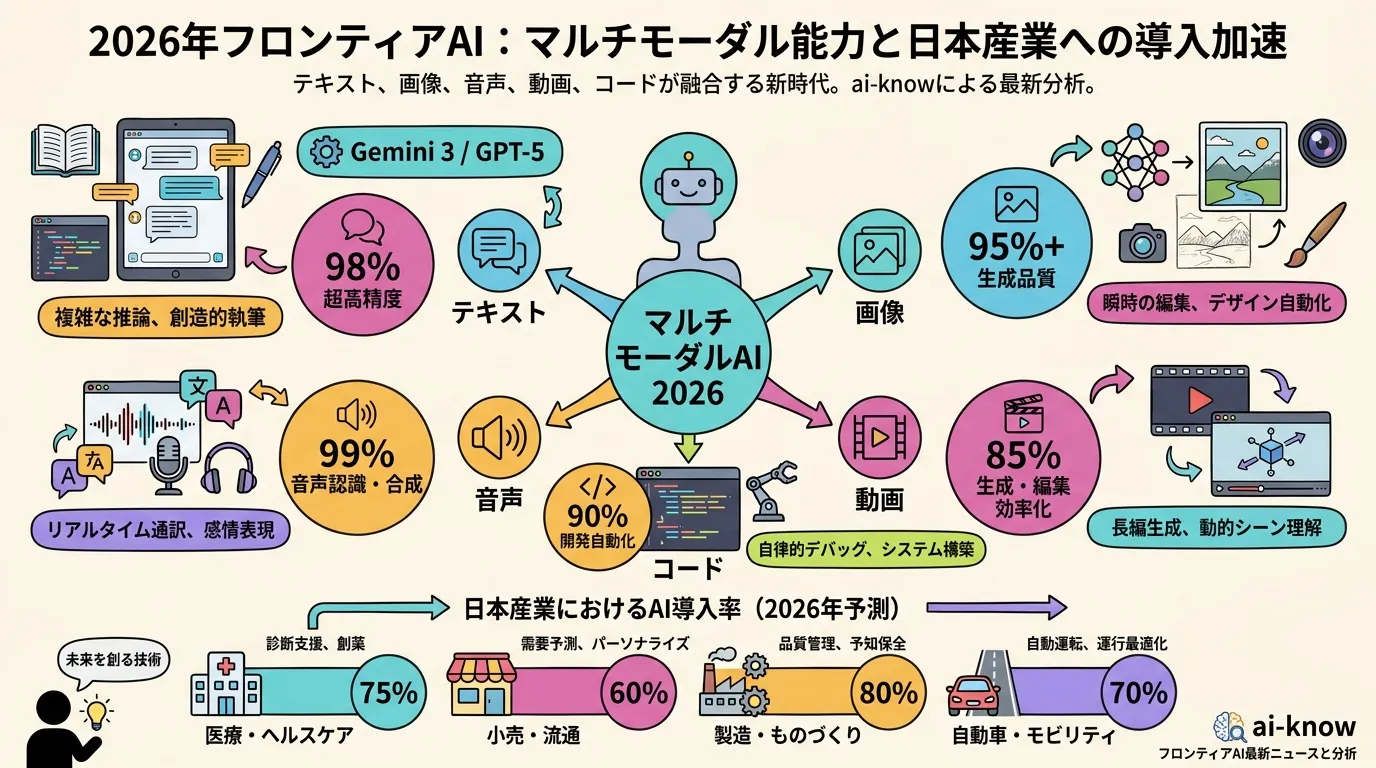
Multimodal LLMs Become Essential Infrastructure: Japan Adoption Trends and the Native Multimodal Shift in 2026
OpenAI's Four-Layer Defense for Codex — Engineering Safe Agentic Code Execution
AI Agent Architecture in 2026: Four Essential Design Patterns for Production
The Year AI Agents Reshape Enterprise Systems — MCP Becomes the Connectivity Standard